
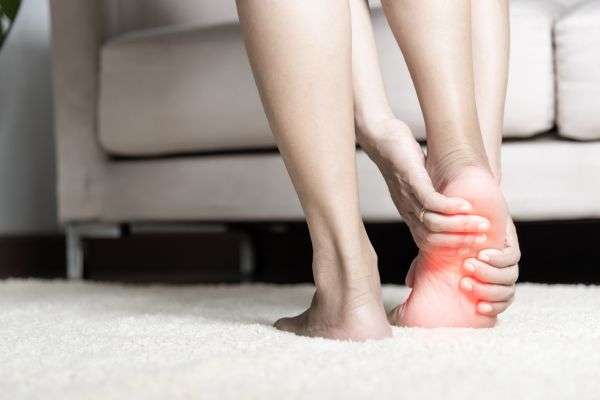
Plantar fasciitis is a degenerative overuse condition of the plantar fascia, the connective tissue band running along the underside of the foot that connects the heel bone to the base of the toes, which causes heel pain, typically at its worst with the first steps in the morning or after prolonged sitting. It is the most common cause of heel pain in adults, responsible for approximately 2 million physician visits in the United States each year.
If your heel pain follows that pattern — sharpest in the first few steps, then easing slightly as you move — a targeted stretching and strengthening routine is the most important thing you can start today. Conservative treatment, including stretching, successfully resolves plantar fasciitis symptoms in 80 to 90 percent of patients when started early and performed consistently, typically within 6 to 12 weeks.
This guide provides a clinically grounded stretching routine endorsed by the podiatrists at Foot & Ankle Centers of New Jersey, with step-by-step instructions, timing guidance, and clear guidance on when to stop. For a broader context on the condition itself, see our complete plantar fasciitis and heel pain guide. For an overview of professional treatment options, see our plantar fasciitis treatment page.
Key Clinical Takeaways
- Plantar fasciitis affects approximately 10 percent of the population over a lifetime and is the leading cause of heel pain in adults.
- A 2003 prospective randomized controlled trial published in the Journal of Bone and Joint Surgery found that plantar fascia-specific stretching produced significantly better outcomes than Achilles tendon stretching alone at eight weeks, with results sustained at two-year follow-up.
- The most effective single stretch for plantar fasciitis is the plantar fascia-specific seated stretch, performed before taking the first steps of the day.
- Calf flexibility directly affects plantar fascia loading; restricted ankle dorsiflexion has been identified as one of the most significant biomechanical risk factors for plantar fasciitis.
- Stretching alone resolves symptoms in the majority of patients when started in the early to moderate stage of the condition and performed consistently twice daily.
- Stretching that produces lasting sharp or increasing pain is a signal to stop and seek professional evaluation, not a sign to push through.

Why Stretching Works for Plantar Fasciitis
The plantar fascia works best when it is pliable and can distribute load evenly across the heel and arch during walking. Plantar fasciitis develops when repetitive stress causes microtears at the insertion of the plantar fascia on the heel bone, leading to a cycle of incomplete healing, thickening, and chronic pain.
During sleep and periods of rest, the plantar fascia shortens. When you load it suddenly with your first steps, the tissue is abruptly stretched before it has warmed up or adapted, which is why morning pain is so characteristic of the condition. This is also why the most important stretch in this entire routine is one you perform before you ever put your foot on the floor.
Stretching addresses the condition at its mechanical root by improving flexibility in the plantar fascia itself, reducing tension in the calf muscles that load the plantar fascia during gait, and strengthening the intrinsic foot muscles that support the arch and reduce compensatory strain on the fascia.
A prospective randomized controlled trial by DiGiovanni and colleagues, published in the Journal of Bone and Joint Surgery in 2003, demonstrated that a program of non-weight-bearing stretching exercises specific to the plantar fascia produced superior outcomes at eight weeks compared with the standard weight-bearing Achilles tendon stretching program. A follow-up study published in 2006 confirmed that those results were sustained at two years. These findings established plantar fascia-specific stretching as the evidence-based standard for conservative management.
Calf flexibility is equally important. The gastrocnemius and soleus muscles connect directly to the heel via the Achilles tendon and share the load management system with the plantar fascia. Research has shown that restricted ankle dorsiflexion — the range of motion limited by calf tightness — appears to be one of the most significant biomechanical risk factors for developing plantar fasciitis. Addressing calf flexibility is not optional in an effective plantar fasciitis stretching program.
General Instructions Before You Begin
- Perform two sessions daily: one immediately before your first steps in the morning, one in the evening.
- Each full session takes 10 to 15 minutes.
- Warm the tissue first; a warm cloth wrapped around the foot for 2 to 3 minutes before your session significantly improves tissue compliance.
- Move into each stretch slowly and hold without bouncing; ballistic stretching increases injury risk.
- Stretch both feet, even if only one side is symptomatic; plantar fasciitis frequently spreads to the second foot when the first is managed in isolation.
- A mild pulling sensation or ache is expected and acceptable; sharp, stabbing, or increasing pain is not.
- If pain increases sharply during a stretch or remains elevated for more than 24 hours following a session, stop that exercise and contact your podiatrist before continuing.
The Morning Routine: Start Before You Stand
This is the most clinically important habit in plantar fasciitis management. Performing the plantar fascia-specific stretch before your first steps dramatically reduces the severity of morning pain by gently restoring tissue length before the fascia is loaded.
Keep a towel, belt, or resistance band next to your bed. Before you stand up each morning, complete the following two stretches while still seated or lying down.
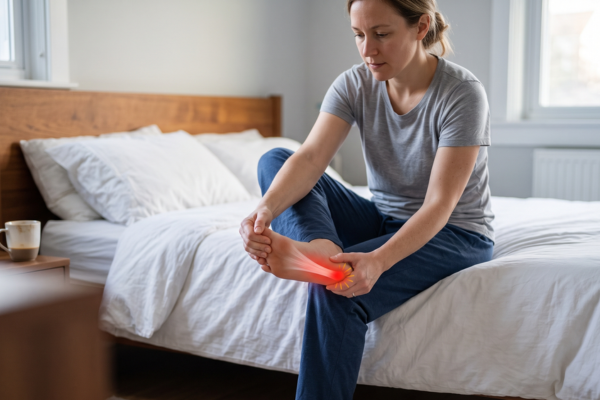
Stretch 1: Plantar Fascia-Specific Seated Stretch
What it targets: The plantar fascia directly at its insertion and throughout its length. This is the DiGiovanni stretch, the most evidence-supported stretch in the clinical literature for plantar fasciitis.
How to perform:
- Sit on the edge of the bed or in a chair with your feet flat on the floor.
- Cross the affected foot over the opposite knee so the sole faces upward.
- Using the hand on the same side, grasp the toes and pull them back toward your shin until you feel a strong stretch along the arch and into the heel.
- With your other hand, palpate the plantar fascia along the arch; you should feel it tighten like a cord as you dorsiflex the toes.
- Hold the stretch for 30 seconds.
- Release slowly. Repeat 3 times.
Frequency: Both sessions daily. This stretch is mandatory before standing each morning.
Progression: Once comfortable at 30 seconds, progress to 45-second holds and increase to 4 repetitions per session.
When to stop: Stop if you feel sharp pain at the heel, any tearing sensation, or sudden increase in arch pain. Mild tension and a strong pulling sensation across the arch are expected and appropriate.
Stretch 2: Towel or Belt Plantar Fascia Stretch (Lying Down)
What it targets: The plantar fascia and the flexor chain of the foot and lower leg. Suitable for patients with limited hip flexibility who find the seated cross-leg position uncomfortable.
How to perform:
- Lie flat on your back in bed.
- Loop a towel, belt, or resistance band around the ball of the foot — not the heel, and not the mid-arch.
- Hold both ends of the towel and gently pull the foot toward you, bending at the ankle to bring the toes toward the shin.
- Keep the knee straight throughout.
- Pull only until you feel a strong stretch along the sole of the foot and calf. Do not force range of motion.
- Hold for 30 seconds. Repeat 3 times per foot.
Frequency: Morning session before standing. Can also be used in the evening session as an alternative to Stretch 1.
Progression: Hold for 45 seconds as flexibility improves.
When to stop: Stop if you feel numbness, tingling in the toes, or sharp pain in the heel. A pulling ache along the arch and calf is expected.
Stretch 3: Standing Gastrocnemius Calf Stretch
What it targets: The gastrocnemius muscle, which crosses the knee and ankle joints. Tightness in the gastrocnemius is a primary driver of increased plantar fascia load during walking.
How to perform:
- Stand facing a wall with both hands placed flat on the wall at shoulder height for support.
- Step one foot back approximately 60 to 90 cm (24 to 36 inches), keeping the back heel firmly on the ground.
- Keep the back knee straight throughout; this is what differentiates the gastrocnemius stretch from the soleus stretch below.
- Lean your body weight forward into the wall until you feel a strong stretch in the calf of the back leg.
- The front knee bends naturally as you lean; this is correct.
- Hold for 30 seconds. Repeat 3 times per leg.
Frequency: Both daily sessions.
Progression: Increase hold to 45 seconds. A slight forward lean from the ankle, rather than bending at the hip, maximizes the stretch.
When to stop: Stop if you feel pain behind the knee, sharp pain in the heel or Achilles, or any snapping sensation. Mild burning in the belly of the calf is expected.
Stretch 4: Seated Soleus Stretch
What it targets: The soleus muscle, which sits beneath the gastrocnemius and is active during most of the walking cycle. Soleus tightness is often overlooked in plantar fasciitis programs, but it contributes significantly to restricted dorsiflexion.
How to perform:
- Sit in a chair with feet flat on the floor.
- Place the affected foot flat, then slide it back slightly until it is directly under the knee.
- Keeping the heel on the ground, gently push the knee forward and slightly outward over the toes until you feel a deep stretch in the lower calf, above the heel.
- This stretch is subtle; the tightness is felt lower in the calf than in the gastrocnemius stretch.
- Hold for 30 seconds. Repeat 3 times per leg.
Frequency: Both daily sessions.
Progression: Perform while standing, with a slight bend in the knee to increase load. This is known as the bent-knee wall stretch.
When to stop: Stop if you feel Achilles pain, ankle instability, or significant discomfort in the heel rather than the calf belly.
Stretch 5: Frozen Water Bottle or Golf Ball Rolling
What it targets: The plantar fascia and the flexor tendons of the foot via plantar surface pressure and gentle mobilisation.
Frozen water bottle method (preferred for acute or inflammatory presentations):
- Freeze a standard water bottle completely.
- Place the bottle on the floor and sit in a chair.
- Place the arch of the affected foot on the bottle.
- Apply moderate downward pressure and roll the foot forward and back, from the heel to the ball of the foot.
- Roll for 2 minutes per foot.
Golf ball method (preferred for subacute or chronic presentations):
- Place a golf ball on the floor.
- Place the arch of the foot on the ball and apply moderate pressure.
- Roll in small circles and along the full length of the arch for 2 minutes per foot.
Frequency: Once daily, preferably in the evening session. The frozen bottle provides therapeutic cold alongside the mobilisation effect, making it particularly useful after a long day on your feet.
When to stop: Stop if rolling produces sharp pain directly at the heel insertion, increasing discomfort that lasts beyond the session, or bruising. Mild pressure, discomfort, and aching during rolling is expected.
Exercise 1: Towel Scrunching (Intrinsic Foot Strengthening)
What it targets: The intrinsic muscles of the foot — the small muscles within the foot itself that support the arch. Weakness in these muscles increases the mechanical load on the plantar fascia during gait.
How to perform:
- Sit in a chair with a small towel laid flat under the affected foot.
- Using only the toes, scrunch the towel toward you by curling the toes inward.
- Hold the scrunched position for 2 seconds, then release.
- Perform 10 repetitions per foot.
- Complete 2 to 3 sets per session.
Frequency: Once daily. This exercise can be performed during the morning or evening session.
Progression: Once the towel scrunch is comfortable, progress to marble pickups: place 10 marbles on the floor and pick them up one at a time with the toes, then place them into a cup. This challenges the intrinsic muscles through a greater range of motion.
When to stop: Stop if cramping in the arch is severe, prolonged beyond 30 seconds after stopping, or if toe pain prevents normal completion. Mild arch fatigue and cramping during the exercise is expected, particularly in the first week.
Exercise 2: Single-Leg Heel Raises
What it targets: The gastrocnemius and soleus through eccentric loading — the same mechanism that has shown strong evidence in Achilles tendinopathy rehabilitation and is increasingly supported for plantar fasciitis as a strengthening progression.
A 2015 randomized controlled trial by Rathleff and colleagues, published in the Scandinavian Journal of Medicine and Science in Sports, found that high-load strengthening exercises, including progressive single-leg heel raises, produced significantly better outcomes in plantar fasciitis at 12-month follow-up compared to stretching alone, with 29 percent more patients achieving a 50 percent or greater reduction in pain.
How to perform:
- Stand near a wall or sturdy chair for balance support.
- Place both feet hip-width apart, toes pointing forward.
- Shift weight onto the affected foot and lift the unaffected foot slightly off the ground.
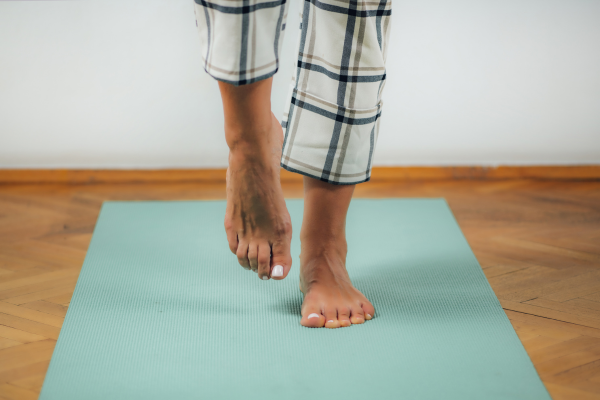
- Slowly raise the heel of the standing foot as high as comfortable over 2 seconds.
- Hold at the top for 1 second.
- Lower slowly over 3 seconds; the controlled lowering phase is the eccentric component with the greatest therapeutic value.
- Complete 8 to 12 repetitions per foot.
- Rest 60 seconds between sets. Complete 2 sets per foot.
Frequency: Once daily, in the evening session. Not appropriate in the morning before the fascia is warmed up.
Progression: Begin with both feet for the first two weeks if single-leg is too uncomfortable. Progress to single-leg as strength improves. A further progression involves performing the exercise on a step with the heel dropping below the step level to increase range of motion and eccentric demand.
When to stop: Stop if you feel sharp heel pain during the lowering phase, calf muscle cramping that does not resolve within a minute of rest, or any instability in the ankle. Moderate calf burn and mild heel ache during the exercise are expected and acceptable.
Your Complete Daily Routine at a Glance
| Session | Timing | Stretches and Exercises | Duration |
|---|---|---|---|
| Morning | Before standing | Stretch 1 (PF-specific seated) or Stretch 2 (towel lying down), Stretch 3 (gastrocnemius wall stretch) | 10 minutes |
| Evening | After activity, before bed | Stretch 3 (gastrocnemius), Stretch 4 (soleus), Stretch 5 (rolling), Exercise 1 (towel scrunching), Exercise 2 (heel raises) | 15 minutes |
Total daily time commitment: 20 to 25 minutes. Consistency matters more than intensity. Two shorter sessions every day produces better outcomes than one long session performed irregularly.
How Long Before You See Improvement?
Most patients performing this routine consistently twice daily begin to notice a reduction in morning pain intensity within 2 to 4 weeks. Meaningful functional improvement — walking without limping, standing for longer periods without pain — typically occurs within 6 to 8 weeks.
The DiGiovanni 2003 randomized controlled trial demonstrated statistically significant improvement in pain and function at eight weeks in patients who performed the plantar fascia-specific stretching program, with these results maintained at the two-year follow-up assessment.
Complete resolution of symptoms, including the ability to return to full activity and high-impact exercise without pain, typically requires 3 to 6 months of consistent conservative management. This timeline is longer than most patients expect; understanding it upfront prevents premature abandonment of a program that is working.
What to Expect in the First Week
The first week of a stretching program often involves a temporary increase in awareness of the heel and arch as tissues that have been guarded and shortened begin to lengthen. This is not a sign of worsening. It is a sign that the tissue is responding.
What is not normal and warrants stopping: sharp pain at the heel insertion during any stretch, pain that increases rather than decreases over the first week of consistent performance, or swelling and warmth in the foot that was not present before starting.
Clinical Experience: Insights From Our Podiatrists
“The morning stretch is the single most important habit change for plantar fasciitis patients and also the one most commonly skipped,” says Dr. Zarefah Farraj-Ahmad, DPM, at Foot & Ankle Centers of New Jersey. “Patients will do the wall stretch twice a day but forget the seated stretch before they stand, and then wonder why their first steps are still agonizing. The tissue shortens overnight. If you load it without restoring its length first, you are repeating the injury mechanism every single morning.”
On the question of which stretches matter most: “I tell patients to think of it as a two-part problem. The plantar fascia-specific stretch addresses the tissue itself. The calf stretches address the mechanical system that loads it. You need both. Doing only calf stretches is like reducing tire pressure while the wheel alignment is still off — you are addressing contributing factors but not the primary structure.”
In clinical practice at Foot & Ankle Centers across our New Jersey locations, patients who perform this full routine consistently for 6 weeks before their follow-up appointment demonstrate significantly better pain scores and functional outcomes than those who stretch intermittently or perform calf stretches only.
When Stretching Is Not Enough: Signs You Need Professional Evaluation
Stretching is highly effective as a first-line treatment for plantar fasciitis when the condition is identified early and managed consistently. It is not always sufficient on its own. Seek professional evaluation if:
- Your pain has not reduced meaningfully after 6 to 8 weeks of consistent twice-daily stretching.
- Morning pain is worsening rather than improving after the first two weeks of the program.
- Pain has spread from the heel into the arch or up the Achilles tendon.
- You are unable to complete normal walking without limping.
- You have diabetes, peripheral neuropathy, or poor circulation — these conditions require professional monitoring of any foot pain, regardless of apparent severity.
- You notice swelling, warmth, or redness in the heel or foot that was not present when symptoms began.
- The pain woke you from sleep or is present at rest, not only with weight-bearing.
These signs do not mean the condition cannot be treated conservatively, but they do indicate it requires clinical assessment to rule out a partial fascial tear, nerve entrapment, a stress fracture, or a condition that will not respond to stretching alone.
Our podiatrists at Foot & Ankle Centers offer a comprehensive evaluation including gait analysis, physical examination, and imaging where indicated. If you have been stretching consistently without adequate improvement, a professional evaluation is the logical next step — not an escalation, but the appropriate continuation of conservative care.
See our plantar fasciitis treatment page for an overview of what professional treatment involves, including orthotics, cortisone injections, and shockwave therapy. For specific guidance on whether your heel pain warrants an appointment now, see our post on when to see a podiatrist for heel pain in New Jersey.
Get Expert Plantar Fasciitis Care in New Jersey
Stretching is a powerful first-line treatment for plantar fasciitis, but it works best when the routine is correct, consistent, and appropriately matched to the stage and severity of your condition. If you have been managing heel pain with stretching alone and are not seeing the results you expected, a podiatric evaluation will clarify why and what the right next step is.
Foot & Ankle Centers of New Jersey has locations in Hamilton, Ewing, East Windsor, Flemington, and Somerset. Our podiatrists assess plantar fasciitis with a full biomechanical evaluation and develop treatment plans that extend beyond generic stretching protocols to include custom orthotics, physical therapy referrals, injection therapy, and shockwave therapy where appropriate.
Find a location near you or book an appointment online.
For further clinical evidence on plantar fasciitis conservative management, see the American College of Foot and Ankle Surgeons clinical practice guidelines: Heel Pain — Plantar Fasciitis.
Medical Disclaimer: This content is for informational and educational purposes only and does not constitute medical advice, diagnosis, or treatment. It should not be used as a substitute for professional medical evaluation, diagnosis, or care by a board-certified podiatrist or other qualified healthcare provider. Individual symptoms, conditions, and treatment responses vary.
If you are experiencing foot or ankle pain, swelling, deformity, injury, numbness, or any concerning symptoms, contact Foot & Ankle Centers of New Jersey or another qualified podiatric physician for evaluation. Do not delay seeking professional medical care based on information read on this website.
In case of emergency, severe injury, uncontrolled bleeding, signs of infection (fever, red streaking, purulent drainage), or diabetic foot complications, call 911 or visit your nearest emergency room immediately.
The physicians at Foot & Ankle Centers of New Jersey are licensed to practice podiatric medicine in the state of New Jersey. Treatment recommendations are based on clinical evaluation and individual patient needs. Results and recovery timelines vary by patient, condition severity, treatment adherence, and other health factors.
Stretches and Exercises for Plantar Fasciitis


